Near Real-Time Altimeter Validation System (NRTAVS)
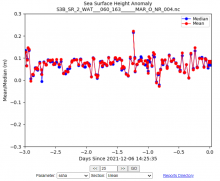
NRTAVS produces comprehensive, running web-based summaries of individual correction terms, as well as wind, wave and sea-surface height for satellite radar altimeter missions.
Quality Assurance (QA) refers to the accuracy, precision, or scientific merit of data
NRTAVS produces comprehensive, running web-based summaries of individual correction terms, as well as wind, wave and sea-surface height for satellite radar altimeter missions.
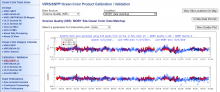
VIIRS Ocean Color Product Calibration / Validation - Science Quality (NIR) Processing: MOBY data matchup
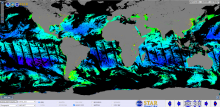
The ocean color science team seeks to develop improved ocean color products from the current and future ocean color satellite sensors including the SeaWiFS, MODIS, and VIIRS on the SNPP and JPSS, as well as various satellite sensors from other countries.
ARMS is a regional monitor with pre-defined regions for multiple satellite platforms and SST product levels.
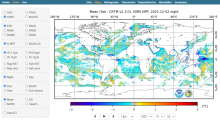
MICROS s a near real time system to monitor and analyze the "Model minus Observation" (M-O) biases in top-of-atmosphere (TOA) brightness temperatures (BT). "Retrieval minus Reynolds" SST biases are also monitored.
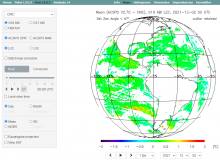
SQUAM monitors global L2 & L3 SSTs with respect to L4 fields & in situ data. It also intercompares and validates various global L4 SST products.
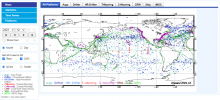
iQuam is a system developed in NESDIS/STAR to perform near real time QC of in situ measurements and monitor the statistics. Ships and buoys (drifters and moorings) are included.
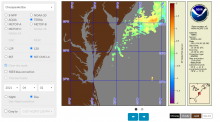
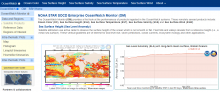
This OceanWatch Monitor provides an easy way for CoastWatch users to assess the state of the available products at one location (under one URL). The current capability includes monitoring of five different environmental data record (EDRs): Ocean Color (OC) Chlorophyll-a, Sea Surface Height (SSH), Sea Surface Salinity (SSS), Sea Surface Temperature (SST) and Sea Surface Wind (SSW) aka Ocean Surface Vector Wind. The OM framework is flexible to accommodate newer products for existing EDRs, and scalable for adding a newer EDR. Besides product monitoring within a given EDR family, it is envisioned to allow a joint analysis of different EDRs under an inter-thematic module. However, not all available CW products have been included in the monitor yet and this will be done incrementally. Likewise, the various data sets may have different latencies depending on their scientific needs. See Quickstart Userguide for more information.
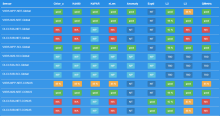
This Data Availability Dashboard gives a concise report of product availability and a quick look at a bulk time series to monitor for product stability